From curiosity to investigation
What does it mean to measure time in an expanding Universe?
We turn this question into mathematical models and hypotheses that can be tested against observations.

THE INQUIRY
Independent scientific investigations · ORAEVA
ORAEVA is more than a narrative universe. Alongside its literary, philosophical and cinematic dimensions, it also pursues independent scientific questions about cosmology, time and the evolution of the Universe.
The first line of inquiry begins from a source of inspiration: Roger Penrose's Conformal Cyclic Cosmology (CCC). From there, intuitions are translated into mathematical models, numerical experiments and questions that can be confronted with observations.
This is research in progress, not an announcement of a scientific discovery. Methods, progress and unresolved problems are shared openly — including results that may contradict the starting idea.
ORAEVA è più di un universo narrativo. Accanto alla dimensione letteraria, filosofica e cinematografica, porta avanti anche indagini scientifiche indipendenti sulla cosmologia, sul tempo e sull’evoluzione dell’Universo.
Il primo filone di ricerca nasce da una fonte di ispirazione precisa: la Conformal Cyclic Cosmology (CCC) di Roger Penrose. Da lì, le intuizioni vengono tradotte in modelli matematici, esperimenti numerici e domande da confrontare con le osservazioni.
Si tratta di una ricerca in corso, non dell’annuncio di una scoperta scientifica. Metodi, progressi e problemi irrisolti vengono condivisi apertamente, compresi i risultati che possono contraddire l’ipotesi iniziale.
What does it mean to measure time in an expanding Universe?
We turn this question into mathematical models and hypotheses that can be tested against observations.
Che cosa significa misurare il tempo in un Universo in espansione?
Trasformiamo questa domanda in modelli matematici e ipotesi da confrontare con le osservazioni.
ORAEVA · THE FIRST INVESTIGATION
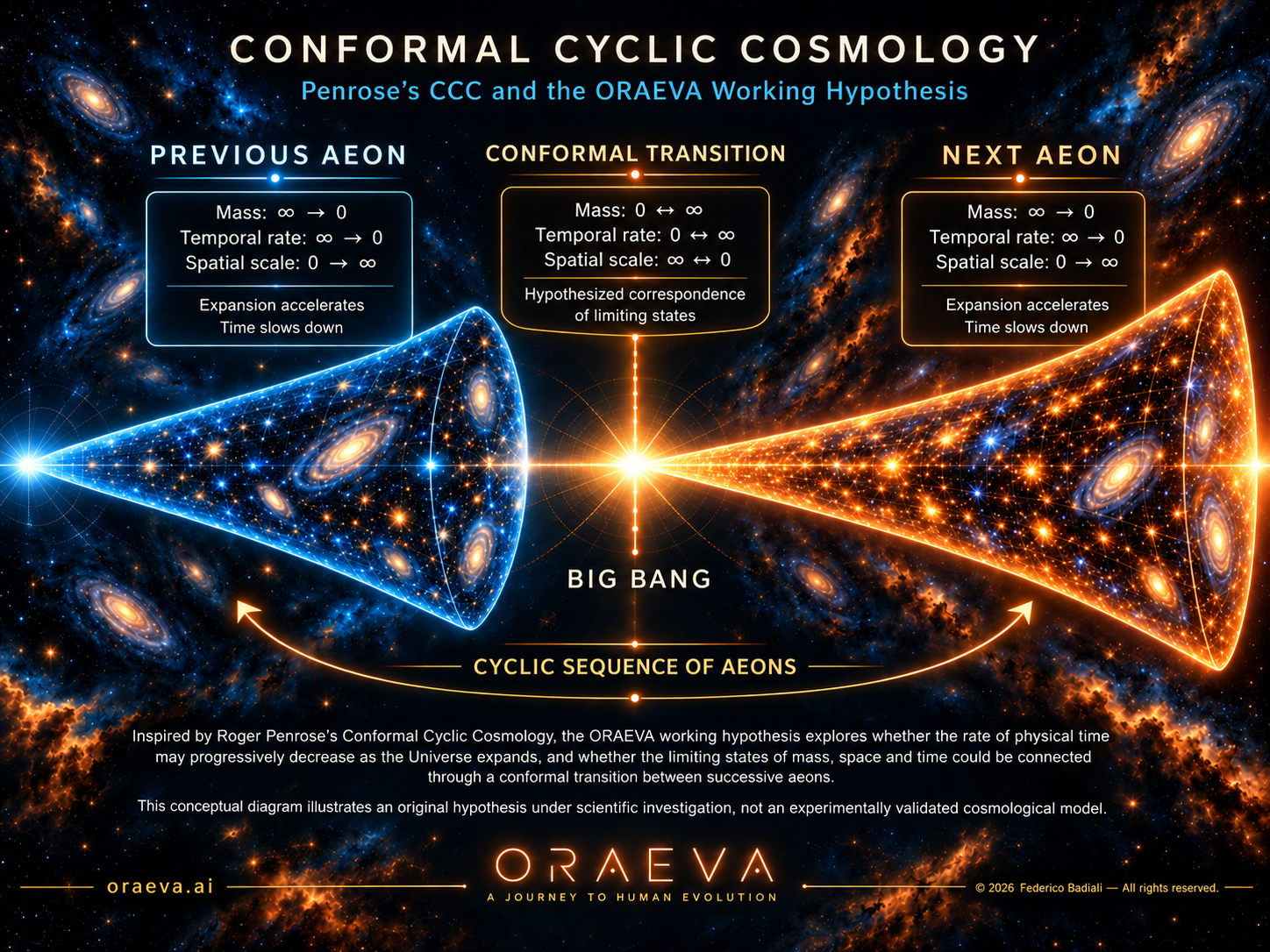
Temporal parametrizations and scalar–tensor models help us examine whether the hypothesis produces measurable predictions.
Our next step is to test those predictions against gravity and cosmological observations.
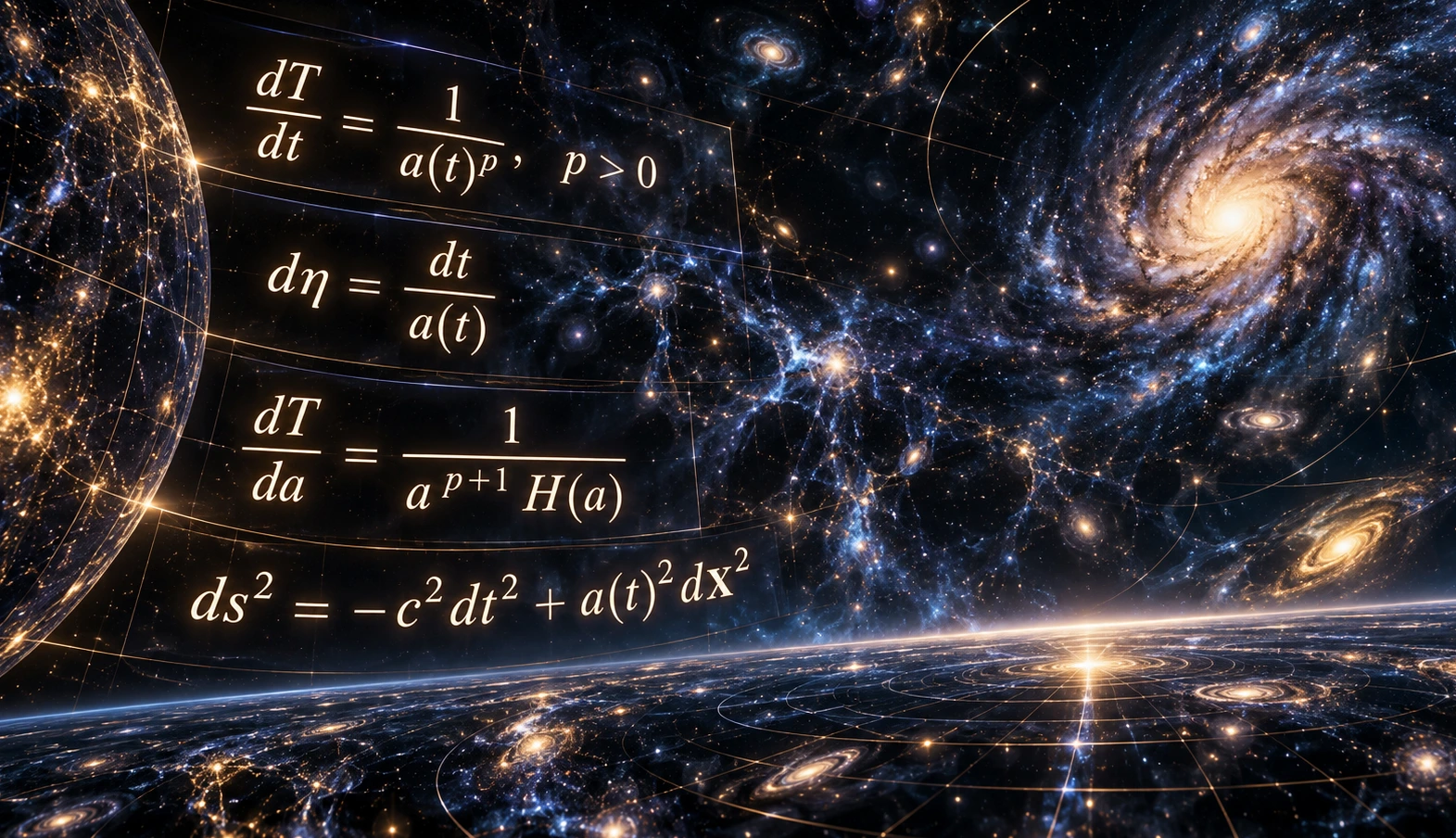
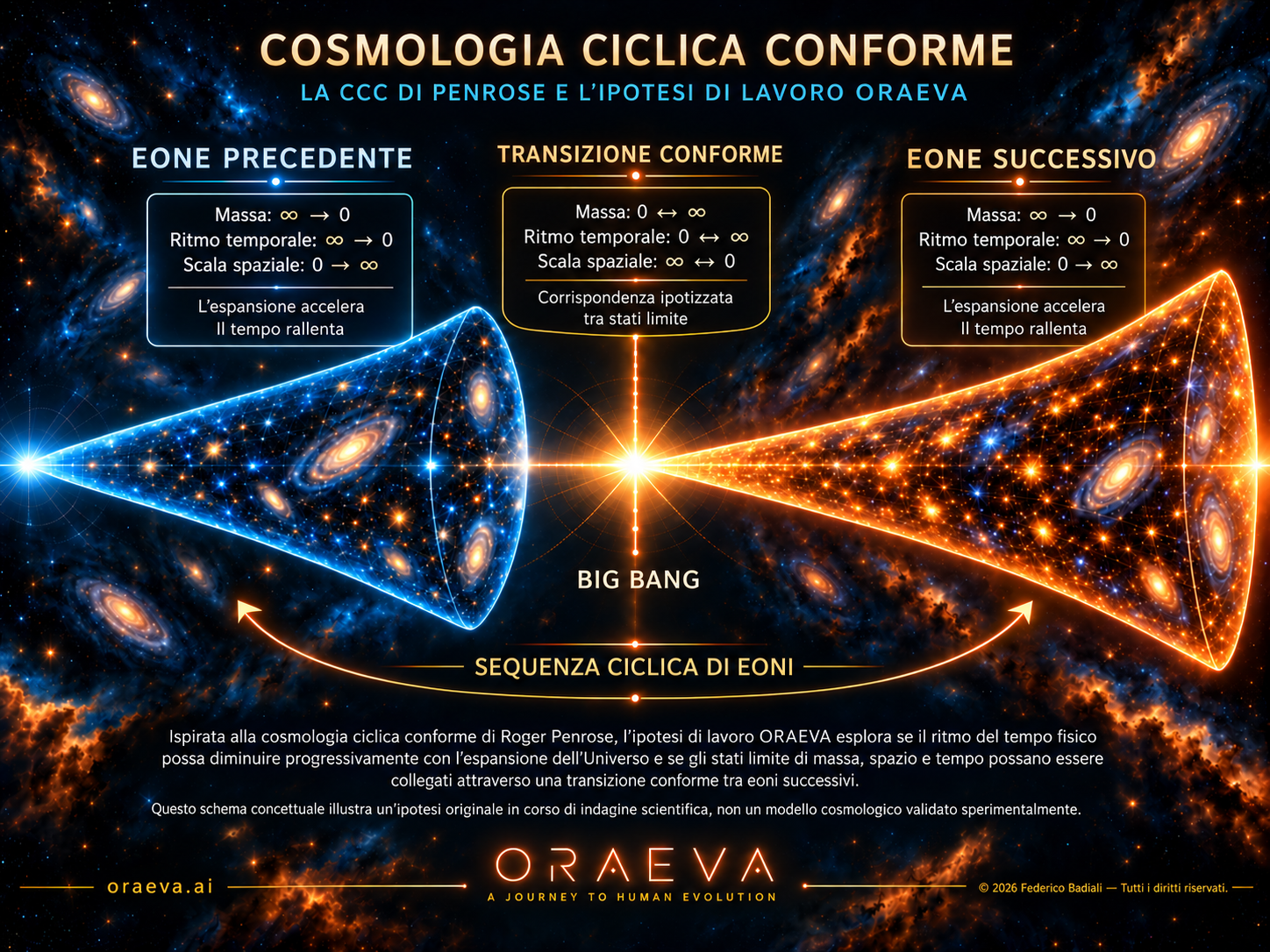
Parametrizzazioni temporali e modelli scalare-tensore permettono di esaminare se l’ipotesi produca previsioni misurabili.
Il prossimo passo è confrontarle con i dati gravitazionali e cosmologici.
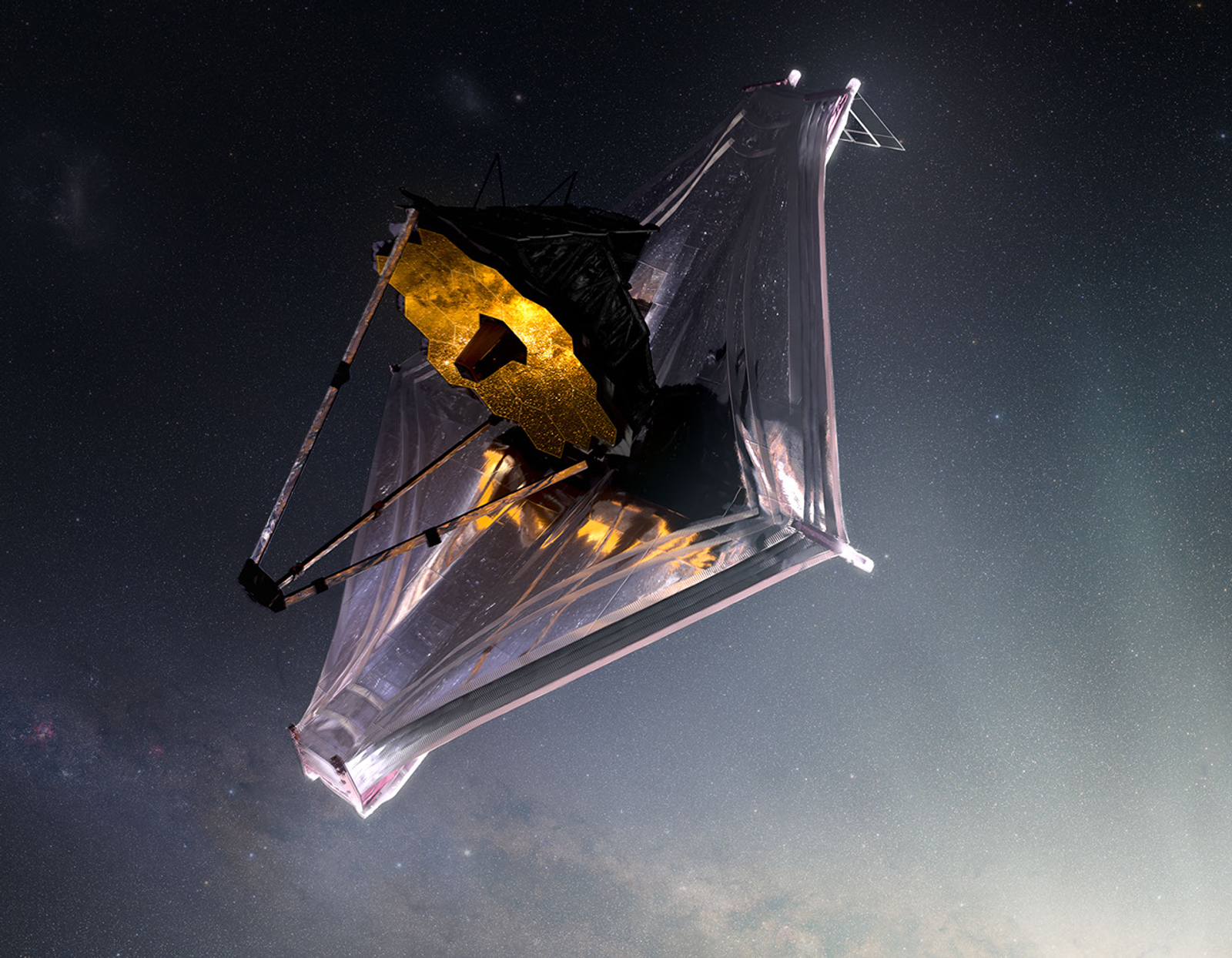
WEBB · OSSERVAZIONI E IPOTESI
Le osservazioni del James Webb Space Telescope aprono nuove domande sull’Universo primordiale. Possono diventare un banco di prova per l’ipotesi ORAEVA, ma non ne costituiscono oggi una conferma.
01 / WEBB
Webb raccoglie luce infrarossa emessa da stelle e galassie lontane. NIRCam ne registra le immagini; la spettroscopia di NIRSpec consente di misurare lo spostamento verso il rosso, o redshift, identificando caratteristiche dello spettro. Non osserviamo queste galassie come sono oggi, ma come erano quando la luce è partita.
Nel quadro cosmologico omogeneo e isotropo, il redshift cosmologico lega le lunghezze d’onda al fattore di scala: 1 + z = λoss / λem = a0 / aem Convertire questo dato in un’età dell’Universo richiede una storia di espansione H(z): l’età non è una misura diretta fornita dalla fotografia. [3]
Per questo, quando si dice «280 milioni di anni dopo il Big Bang», si sta già interpretando l’osservazione entro un modello cosmologico. Cambiare modello richiede di ricalcolare coerentemente tempi, distanze e proprietà fisiche dedotte.
02 / WEBB
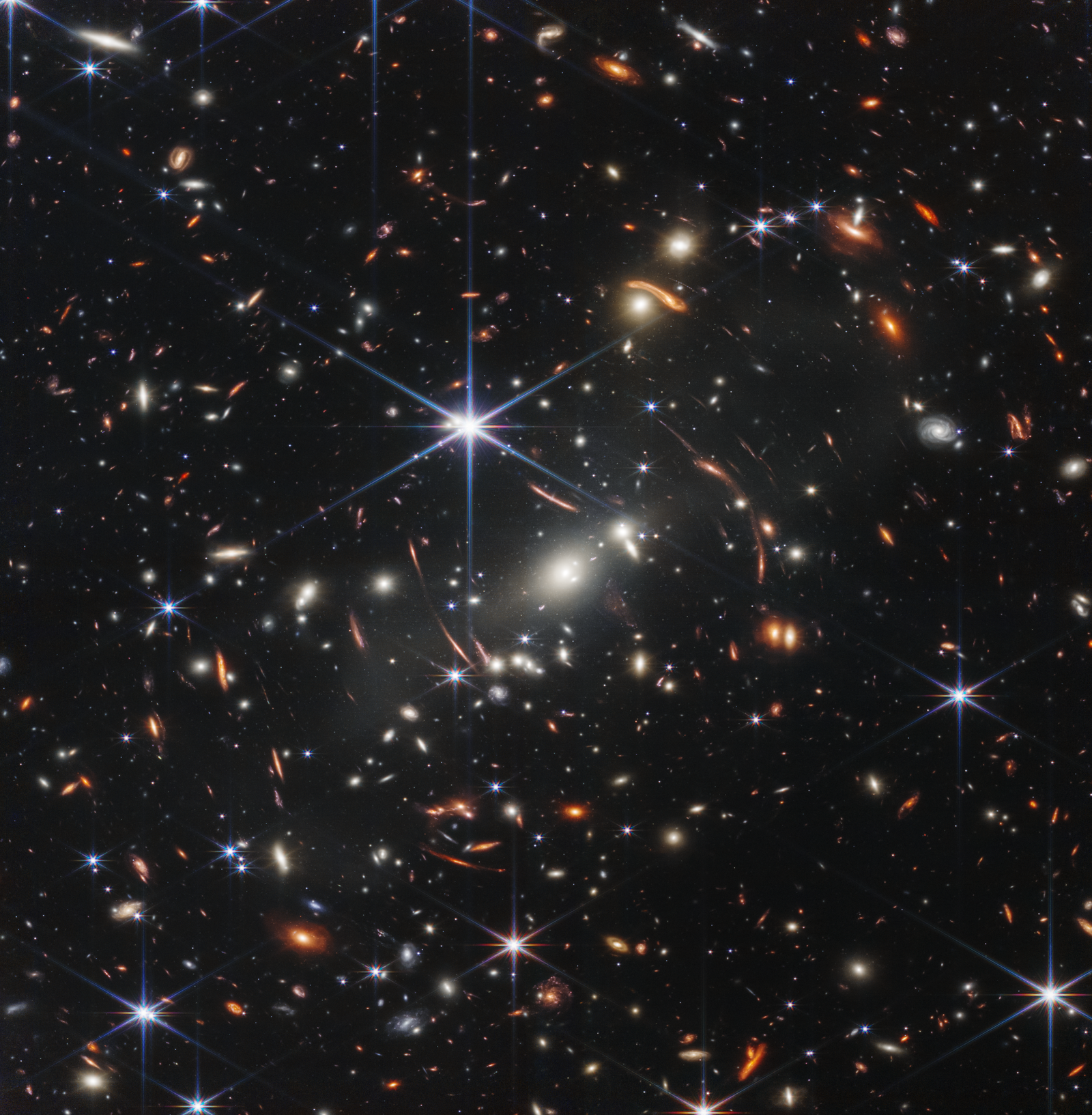
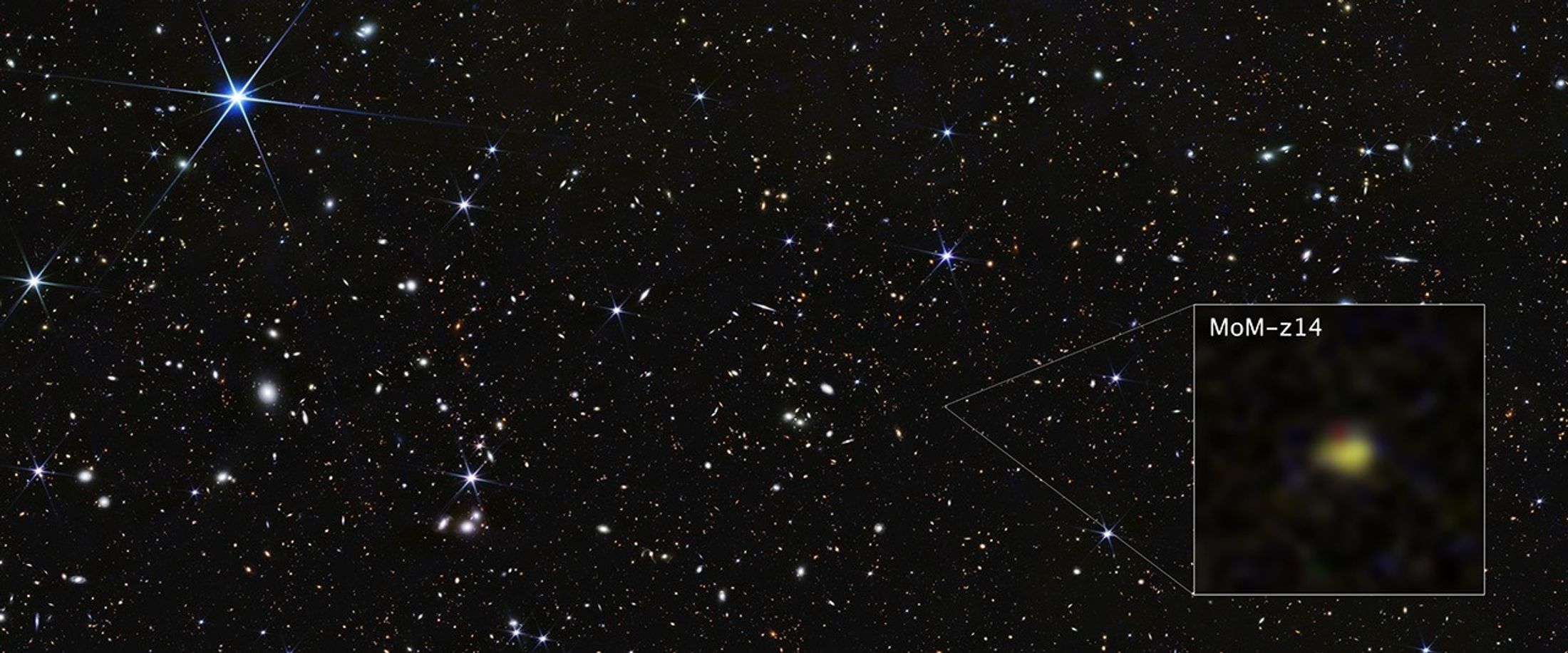
Webb ha individuato popolazioni di galassie molto luminose a redshift elevato, più abbondanti di quanto previsto da diversi modelli precedenti al suo lancio. MoM-z14 ha un redshift spettroscopico z = 14,44 ± 0,02, corrispondente a circa 280 milioni di anni dopo il Big Bang nella cosmologia adottata dagli autori. [1, 4]
Il suo spettro suggerisce formazione stellare intensa e un particolare arricchimento in azoto. Questo non equivale a osservare una galassia «già vecchia»: lo studio indica una popolazione stellare giovane. Luminosità, massa, età e composizione chimica sono grandezze distinte, ricostruite con incertezze e ipotesi sui processi stellari. [1]
Le spiegazioni da confrontare includono formazione stellare più efficiente o episodica, diverse popolazioni di stelle, polvere e contributi di nuclei galattici attivi. Per alcuni campioni, separare la luce associata ai buchi neri ha ridotto le masse stellari stimate e la tensione con il modello standard. Le sorprese di Webb non costituiscono quindi, da sole, una confutazione della cosmologia ΛCDM. [2]
03 / WEBB
La domanda proposta da ORAEVA è se una diversa relazione fisica tra espansione cosmica e tempo possa consentire una maggiore evoluzione delle strutture a un dato redshift. È una direzione di ricerca: non è ancora una previsione quantitativa verificata del modello, né una conseguenza accertata della cosmologia ciclica conforme di Penrose.
Parlare di «tempo più veloce» ha significato osservativo soltanto se si specificano gli orologi e i processi da confrontare. Una semplice riparametrizzazione temporale lascia invariate le osservabili: non aggiunge tempo proprio alla vita delle stelle. Occorre una differenza fisica nel rapporto tra espansione, dinamica gravitazionale ed evoluzione della materia.
Il test dovrà confrontare previsioni definite prima del confronto con i dati — abbondanza delle galassie, luminosità, masse stellari e indicatori chimici — con campioni osservativi, includendo selezione, errori e spiegazioni alternative. Un accordo su una singola galassia non basterebbe; un disaccordo sistematico potrebbe invece escludere una specifica versione del modello.
Nella descrizione FLRW, con t tempo proprio degli osservatori comoventi e H = (1/a) da/dt, vale dt/dz = −1/[(1+z)H(z)]. Per una storia di espansione con origine al Big Bang, l’età al redshift z è:
t(z) = ∫z∞ dz′ / [(1 + z′) H(z′)]Questa relazione geometrica [3] non fornisce da sola una nuova teoria. Un cambio di variabile dτ = f(t)dt, se applicato coerentemente a tutte le equazioni, non modifica le previsioni fisiche.
In un eventuale modello scalare-tensore è necessario specificare la metrica a cui la materia si accoppia e il tempo misurato dagli orologi fisici; vanno poi calcolati insieme espansione, crescita delle perturbazioni ed evoluzione stellare. Non è coerente aumentare soltanto l’età disponibile mantenendo automaticamente invariate distanze, luminosità e masse dedotte con ΛCDM.
La stessa soluzione dovrà soddisfare vincoli indipendenti: nucleosintesi primordiale, fondo cosmico a microonde, distanze cosmologiche, crescita delle strutture e test gravitazionali, incluse eventuali variazioni della gravità effettiva. Il collegamento con Webb resta una proposta di verifica futura, non un risultato già ottenuto.
WEBB · OBSERVATIONS AND HYPOTHESES
James Webb Space Telescope observations raise new questions about the early Universe. They may offer a testing ground for the ORAEVA hypothesis, but they do not currently confirm it.
01 / WEBB
Webb collects infrared light emitted by distant stars and galaxies. NIRCam records images; NIRSpec spectroscopy enables redshift measurements by identifying spectral features. We see these galaxies as they were when their light was emitted, rather than as they are today.
In homogeneous and isotropic cosmology, cosmological redshift connects wavelengths to the scale factor: 1 + z = λobs / λem = a0 / aem Translating this measurement into a cosmic age requires an expansion history H(z): age is not read directly from an image. [3]
Thus, “280 million years after the Big Bang” already interprets an observation within a cosmological model. Changing that model requires a consistent recalculation of times, distances and inferred physical properties.
02 / WEBB
Webb has identified populations of very luminous galaxies at high redshift that are more abundant than several pre-launch models predicted. MoM-z14 has a spectroscopic redshift z = 14.44 ± 0.02, corresponding to approximately 280 million years after the Big Bang in the cosmology adopted by the authors. [1, 4]
Its spectrum suggests intense star formation and unusual nitrogen enrichment. This does not establish that the galaxy is “already old”: the study indicates a young stellar population. Luminosity, mass, age and chemical composition are different quantities, inferred with uncertainties and assumptions about stellar processes. [1]
Competing explanations include more efficient or episodic star formation, different stellar populations, dust and active galactic nuclei. For some samples, separating light associated with black holes has reduced inferred stellar masses and tension with the standard model. Webb’s surprises therefore do not, by themselves, refute ΛCDM cosmology. [2]
03 / WEBB
ORAEVA asks whether a different physical relationship between cosmic expansion and time could allow more structural evolution at a given redshift. This is a research direction: it is not yet a quantitatively tested prediction of the model, nor an established consequence of Penrose’s Conformal Cyclic Cosmology.
A “faster flow of time” has observational meaning only when the clocks and processes being compared are specified. Merely reparametrizing time leaves observables unchanged: it does not add proper time to stellar lifetimes. A physical difference in the relationship between expansion, gravitational dynamics and matter evolution is needed.
The test must confront predictions specified before comparison with data — galaxy abundances, luminosities, stellar masses and chemical indicators — with observational samples, accounting for selection, errors and alternatives. Agreement with one galaxy would not suffice; systematic disagreement could rule out a particular version of the model.
In FLRW cosmology, where t is the proper time of comoving observers and H = (1/a) da/dt, dt/dz = −1/[(1+z)H(z)]. For an expansion history with a Big Bang origin, the cosmic age at redshift z is:
t(z) = ∫z∞ dz′ / [(1 + z′) H(z′)]This geometrical relation [3] does not by itself provide a new theory. A change of variable dτ = f(t)dt, applied consistently to all equations, does not change physical predictions.
In a possible scalar–tensor model, the metric to which matter couples and the time measured by physical clocks must be specified; expansion, perturbation growth and stellar evolution must then be calculated together. Increasing the available age alone while automatically retaining distances, luminosities and masses inferred under ΛCDM would be inconsistent.
The same solution must also satisfy independent constraints from primordial nucleosynthesis, the cosmic microwave background, cosmological distances, structure growth and gravitational tests, including any variation in effective gravity. The Webb connection remains a proposed future test, not a result already obtained.
RESEARCH PROGRESS
Starting from an intuition about cosmic expansion and the rate of time, we developed an initial mathematical formulation, explored a scalar–tensor gravitational model and numerically checked the consistency of its implemented equations. We also identified the distinction between physical effects and changes of time coordinates.
Partendo da un’intuizione sul rapporto tra espansione cosmica e ritmo del tempo, abbiamo sviluppato una prima formalizzazione matematica, esplorato un modello gravitazionale scalare-tensore e verificato numericamente la coerenza delle equazioni implementate. Abbiamo inoltre identificato le condizioni che distinguono un effetto fisico da un semplice cambiamento di coordinate temporali.
Test the model against astronomical and gravitational observations, identify any measurable new predictions and investigate a possible connection with Roger Penrose’s Conformal Cyclic Cosmology.
Verificare la compatibilità del modello con le osservazioni astronomiche e gravitazionali, individuare eventuali nuove predizioni misurabili e approfondire il possibile collegamento con la cosmologia ciclica conforme di Penrose.
PRELIMINARY RESEARCH · PHYSICAL VALIDITY NOT YET ESTABLISHED
OPEN RESEARCH
Read the introductory note, inspect the reproducible Python code and examine the numerical output. These materials document work in progress and are provided for critical review.
Scope, assumptions, equations, limitations and next tests.
READ / DOWNLOADPython source code used in the current numerical check.
DOWNLOAD CODEOriginal recorded output, including consistency diagnostics.
DOWNLOAD OUTPUTCURIOSITY IS ONLY THE BEGINNING
The value of an idea is not that it survives every test. It is that it is worth testing.
ORAEVA · CREATED BY FEDERICO BADIALI